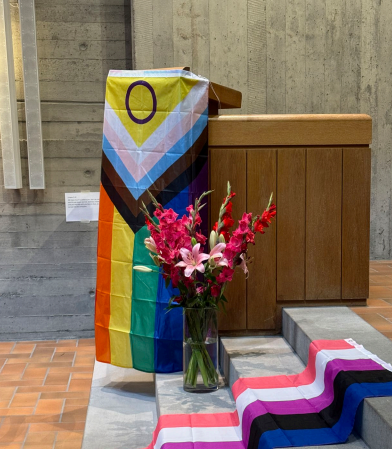
Trans Joy celebrated in Switzerland

By Lewis Reay (From Seeds October – November 2025)

On the weekend of 11-13 July, 28 trans and non-binary Christian activists from all over Europe met in Zurich, Switzerland, to worship together and explore the theme of Trans Joy.

People came from all over Europe, including from Sweden, Finland, Norway, Switzerland and Latvia, sharing stories of the lives of trans and non-binary in their respective countries.

There were four of us from the Metropolitan Christian Church (MCC): Kuisma Savisalo and Ipa Kivinen from Finland, Lewis Reay and the Revd Elder Maxwell Reay from Scotland. Sharing with others the inclusive and affirmative experiences that we have had as part of MCC was a moving experience.

We realised that there was much that we had in common. Both in relation to the struggles that trans and non-binary people face across Europe and the worsening human rights record of many countries. The withdrawal of gender-affirming care for young trans and non-binary people was a common experience.

There were workshops, space for creative activities, panel discussions to learn from one another’s experiences, and worship. There was time for lament and time to express trans joy and gender euphoria.

Kuisma Savisalo from Elävä vesi MCC (Living Water MCC), Helsinki in Finland, said, ‘To meet people who face the same problems in life and share the same joy as us was precious … Getting to know young people from all over Europe was interesting.’

Maxwell Reay, from Our Tribe at Augustine United Church, reflected on the impact of MCC. He said, ‘It is clear we have had great influence in encouraging other denominations to become more inclusive but there is still a place for us, with lots more to do’.

Creating hope in difficult times is so important to give trans and non-binary people the strength to carry on and live authentic lives. Coming home to our bodies and finding trans joy is a wonderful experience. Meeting other trans and non-binary Christian activists was a deeply spiritual experience and friendships were forged. We all hope that this will be the first of many such gatherings.

Trans Joy was organised by the European Forum of LGBTI+ Christian Groups in partnership with Reformierte Kirche Zürich, with the support of LGBTIQ Fachstelle of the Reformed Church of Zürich, Transblessing (Sweden) and Sybils (UK), and funding from the Dutch Government.

A Prayer for Trans Joy

Loving Creator, Holy One, we celebrate your Love and the joy that this brings.
We are beautiful, made in Your marvellous image.
Brothers, sisters and siblings – all our chosen family, a family made by You.
A place to share love and comfort, to laugh and to cry out.
A place to celebrate our joy and a place to mourn as well.
Safety is in Your unchangeable Love, more and deeper than we can know.
Acceptance is a glorious place where hatred falls away, replaced by wholeness.
Risen One, You bring us the joy of new life – renewed and remade.
This is our trans joy in You.
Thank You, for Your boundless Love.
Thank You, for our trans siblings.
We live in the name of the Creating One, the Life-giver and the breath of Spirit.
Sharing the fruit of the earth

By Revd Fiona Bennet (From Seeds October – November 2025)

Earlier this year, I read a very inspiring book by Robin Wall Kimmerer called The Serviceberry: an economy of gifts and abundance.*

Robin is a botanist. She looks at the life of the serviceberry (a bush with fruit that can be eaten by animals and people) and asks what economic model it reveals to us.

The bush produces abundant sweet ripe berries, to entice other creatures to eat so that they will then spread its seed. The bush does not eat the sweet berries for its own nourishment, it is nourished by the soil, rain and sun. It receives its nourishment freely and gives its fruit freely in the cycle of living.

It does not claim to own its fruit, nor does it hoard back its fruit for a ‘rainy day’; it lives in an economy of reciprocity where it freely receives what it needs to live, and protects its species for a ‘rainy day’ by investing its fruit in the stomachs of others. No one has told it that economies are based on the principle of scarcity and individual protection.

The economy of the serviceberry and the planet is reciprocal, creating its own culture of balance and respect. It is an economy which invests its profits in its neighbour’s ‘stomach’, and trusts and protects not individual wealth but collective abundance.

How egotistical we humans are to think we can own what the earth freely gives.

How deceptive and stupid we are to trick ourselves into hoarding selfishly out of fear, when the planet offers us life abundantly and models for us the wisdom of reciprocity.

How fortunate we are to be alive within the reciprocal economy of life, which, despite how it may feel at times, is shaped, energised and sustained by forces and wisdom greater than humanity.

How blessed we are when we recognise and live reciprocally, with gratitude and respect.

In the words of the Revd Kathy Galloway, who sadly died recently:

Oh, the life of the world is a promise of blessing, in the rain that renews, in the heat of the sun; in the heart that confesses and the act that expresses all things and all people are one. Oh, the life of the world is the breath of our being, it is fragile and precious and offers a choice; shall we share the earth wisely, can we touch the earth gently, will we listen to earth’s silenced voice?

* The Serviceberry is published by Penguin. A very good summary of it was published in Emergence

Paradise at AUC

We’re delighted to have Paradise Green back with us, transforming our city centre church into 5 (yes, 5!) venues.

You can explore the shows on offer using these links:

Paradise In Augustine’s – George IV Bridge

Spaces:

Link: https://tickets.edfringe.com/venues/paradise-in-augustines

Paradise In The Vault – Merchant Street*

Spaces:

Link: https://tickets.edfringe.com/venues/paradise-in-the-vault

*To access Paradise in the Vault from the main entrance of AUC: cross over George IV Bridge, walk past Greyfriars Bobby and down Candlemaker Row and go under George IV Bridge (Merchant Street). This will take you to the Pend where you can access Paradise in the Vault spaces.

Services during the Fringe

We also have one alteration to our usual worship pattern this month:

Sunday 24th – we’re off on our annual pilgrimage with our TLC Partners Greyfriars Kirk and St Columba’s by the Castle. There will be no worship in the building on this day or online.

All other Sunday services will run as planned during the Fringe.

Please note: the Sanctuary has now been transformed into a theatre, so if you’ve not been to church in-person or joined us online either through Zoom or YouTube during Fringe before, prepare yourself for it to look quite different! And do bear with us if there are any teething problems or snags.

Seeking the Sacred: what’s on at the festivals?

From Seeds August – September 2025

Do faith and theatre not mix? Oliver Cromwell thought so. Theatre, he said, was a very bad thing. (Or are we doing him an injustice? Discuss!)

Whatever Oliver thought, this year’s Edinburgh International Festival invites audiences to reflect on the theme ‘The Truth We Seek’.

This somewhat echoes the New Testament Gospel of John: ‘And you will know the truth, and the truth will make you free.’ If nothing else, the theme is a striking lens through which both the Festival and the Fringe might explore faith, belief, and spiritual resilience.

If that’s your interest, and you’re in Edinburgh this August, here’s a few options. Others are available.

We’ve already mentioned the Festival of Sacred Art (see page 3 of Seeds August – September 2025), but opening the International Festival is Sir John Tavener’s monumental eight-hour choral masterpiece The Veil of the Temple, in only its second-ever UK performance. It draws on sacred texts from multiple world religions and is performed by over 250 singers in five languages. Those who know it say the result is more than a concert – it’s a shared act of contemplation, echoing the timelessness of spiritual ritual. (‘Complementary tea, coffee and biscuits will be available throughout the performance…’)

Meanwhile, at the Fringe (where the typical show time is just one hour) the search for deeper truths takes less demanding forms. Pilgrim of Hope is a one-man show from writer-performer Stephen Callaghan, who asks: Where does one find hope today? ‘A funny, poignant fable about life, death, air-fryers and one man’s search for hope.’

Very different will be A Period of Faith, Angela King’s onewoman play about how belief sustains through trauma. Framed by the experience of PMDD (premenstrual dysphoric disorder), it’s an account of finding strength in faith while navigating chronic illness and emotional hardship.

One of the strongest hubs for faith-related performance this year is Palmerston Place Church (Venue 254), where Searchlight Theatre Company is in residence. Their programme includes stories of faithful lives: Olympic champion Eric Liddell, wartime chaplain Woodbine Willie, and the Revd W. Awdry, the cleric/train enthusiast behind Thomas the Tank Engine. C.S. Lewis questions Aslan and there’s an adaptation of his The Screwtape Letters. Meanwhile, a church minister and a shipping executive meet in Titanic: The last hero and the last coward.

Also at Palmerston Place, The Passion retells Christ’s final days from the perspectives of Peter, Mary Magdalene and a Roman centurion named Marcus, while shanties feature in tales of the first disciples in Salt and Light.

Elsewhere Fischy Music are in concert with Christian music for children, The Lost Priest is (surprisingly) about growing up Jewish in America, and – because this is the Fringe, after all – Four Door Theatre presents Sex and God.

Across these works (and these are just the tip of the cultural iceberg), artists ask what it means to believe – whether in God, beauty, or one another – in an age of uncertainty. Their approaches vary, but all echo that central question: What is the truth we seek?

Climate crisis – is there any good news?

From Seeds August – September 2025

In a world increasingly shaped by wildfires, floods, and record-breaking heat, Christian hope is something different from optimism.

Hope is grounded in God’s dream for the world, requiring energy and commitment even when the dream appears world-weary and tattered.

And surely it helps even faithled hope to read or hear signs of good news, however fragile, and however sceptical we might feel about what governments are or are not doing. While the climate crisis undeniably remains urgent, a few recent developments suggest some momentum building – in policy, justice, and clean energy.

In the UK, the Climate Change Committee (CCC) recently reported that since 1990, the UK has cut greenhouse gas emissions by nearly 50% as the economy has started, tentatively, to grow. The CCC acknowledged that more action is needed, particularly in heating and agriculture, but it confirmed that net zero by 2050 is still achievable – if government action keeps pace. It’s a reminder that targets are important, and achievable with consistent effort, innovation, and policy support.

Second, a landmark ruling from the International Court of Justice (ICJ) could reshape how climate inaction is judged under international law. The case was brought by Pacific Island nations, led by the low-lying island of Vanuatu. They argued that countries have a legal duty to prevent climate harm. The ICJ agreed. In what has been described as a David versus Goliath ruling, the ICJ affirmed that states must protect both current and future generations from environmental damage.

Lea Main-Klingst, a lawyer at ClientEarth, called the decision a breakthrough: ‘The age of producing and bankrolling fossil fuels with abandon is over. This new-found clarity will equip judges with definitive guidance that will likely shape climate cases for decades to come.’

The ruling isn’t legally binding, but its moral weight could strengthen future climate litigation and diplomatic pressure.

And finally, as the global energy transition appears to be accelerating, UN Secretary-General António Guterres said that ‘fossil fuels are running out of road’. In 2024, 92.5% of all new electricity capacity came from renewable sources, including solar, wind, and hydro.

He didn’t deny that there have been serious setbacks. In the United States, clean energy programmes have faced major cuts, and climate research has been defunded under the second Trump administration. Globally, emissions still reached new highs in 2024, revealing the gap between progress and impact.

But Guterres said, ‘Countries that cling to fossil fuels are not protecting their economies – they are sabotaging them. The fossil fuel age is flailing and failing’, and he highlighted the role of renewables in strengthening global energy security. ‘There are no price spikes for sunlight, no embargoes for wind,’ he said.

Taken together, do these developments offer cautious hope? They show that carbon cuts are possible, that legal frameworks are evolving, and that renewables are no longer aspirational but are a present-day force. At the same time, they underscore how fragile and uneven this progress remains.

The path ahead requires urgency and resolve. But in a year of mixed signals, these breakthroughs remind us that change is happening – and that a liveable future is still within reach.

Can we make dying good?

From Seeds August – September 2025

What are your thoughts about assisted dying? Have you worked out your point of view (and has it changed over the years)?

Do you still have a host of different questions? The United Reformed Church has wrestled with the issues over the years and has returned to them as current legislative proposals pass through the UK’s parliaments.

On 20 June, Westminster MPs narrowly approved the landmark Terminally Ill Adults (End of Life) Bill by 314 votes to 291. If passed into law, the Bill could bring major social change by giving terminally ill adults in England and Wales the legal right to end their own lives. Issues around assisted dying are being discussed by legislators across the four nations. The Isle of Man allows assisted dying, and Jersey is in the latter stages of legal preparation for this.

The Scottish Parliament is working on detailed legislation with a bill having already passed Stage 1.

The Terminally Ill Adults Bill, passed by the House of Commons in Westminster, is now subject to further scrutiny through various stages in the House of Lords. MPs will then get a final say when they have looked at any proposed changes. This is the point at which the bill will officially become law, unless it runs out of parliamentary time or those in the House of Lords who oppose the bill find a way to block it.

The United Reformed Church’s General Assembly last discussed assisted dying in 2007. It said a number of things, including that, ‘as Christians, we regard all human life as being God given, and therefore precious; we believe that death is not the end and we have faith that there is a more perfect life to follow’. The URC recognised that ‘there is a time to die and that there are circumstances in which it will be wrong to continue to provide treatment designed to prolong life’.

The Church recognised the value of good palliative care and that additional resources were needed (even then) to make it more uniformly available. However, it also stated:

‘We could not support legislation that would empower medical staff to intervene in ways which deliberately seek to assist a patient to die. We would therefore oppose any change in the law to permit voluntary euthanasia or assisted suicide.’

As legislation advances in all of the UK’s four nations, the URC has offered prayers to help us all navigate the complex issues around assisted dying. Here is one of them. Others can be found on the URC website – just type ‘terminally ill’ into the search bar.

A FULLER LIFE AWAITS

Eternal One,
we pray for our legislators,
faced with complex lives, situations, and finances,
and trying to discern right from wrong,
in the face of high-powered campaigns.

Suffering Lord,
You walk with us in our pain, bewilderment, and grief,
give grace to those who approach the end of life,
wisdom to clinical staff who care for them,
and time for loving farewells.

Renewing Spirit,
remind us that death is not the end,
that a new, fuller, life awaits us,
where there will be no more death, sorrow,
mourning or crying.

Amen

The cost of discipleship

By Rev Fiona Bennett (From Seeds August – September 2025)

Jesus said, ‘You have heard that it was said, Love your neighbour and hate your enemy. But I tell you, love your enemies and pray for those who persecute you.’ Matthew 5:43-44.

He was making reference to ‘Do not seek revenge or bear a grudge against anyone among your people, but love your neighbour as yourself. I am the Lord’ (Leviticus 18:19)

It is not always easy to love those around us. Jesus knew that.

He lived in a world of Roman occupation, where alongside the usual personality clashes and fallings out of families and communities, there were divisions and factions within the occupied Jewish people and a fear and resentment of the occupying Roman powers.

To love your neighbour was not easy, but Jesus challenged his hearers to go further; not only to love their neighbours but also their enemies.

News headlines, social media likes, gossip, and justification for violence are so easily fuelled by fear and hatred, and turn people (and systems) into enemies. It takes discipline as Christians to pursue love rather than being consumed by hate or fear

I recently met a very compassionate person from a town in southern Germany with a significant population of immigrants. They commented that, ‘Sure there are issues, but we must not lose sight that these are people, not problems; they are diverse beautiful people, with harsh and often painful stories.’

They reminded me that the heart of compassion is looking at others (and ourselves) as multi-layered and complex beings who are known and loved by God. I may find someone’s behaviour or views offensive and deeply wrong, but part of my discipline as a disciple is to recognise that there will always be more to that person than the aspects of them which disturb me, and in that recognition to seek to love them.

“There will always be more to them than what disturbs me”

Writing in 1937 under the shadow of the rise of Nazism, Dietrich Bonhoeffer in his book The Cost of Discipleship wrote, ‘The will of God, to which the law gives expression, is that people should defeat their enemies by loving them.’

Loving ourselves, our neighbours and our enemies is a costly discipline; but a discipline which offers a peace (individually and collectively) which no defeat by violence can ever achieve. It is not easy to love, but it is the only way of true hope for us all.

Forgiveness from the Rubble

By Rev Fiona Bennett (From Seeds June – July 2025)

In May this year, I joined the Community of the Cross of Nails (CCN) for a retreat on Lindisfarne.

Following the destruction of Coventry Cathedral during the bombing of the city in November 1940, Provost Dick Howard made a commitment not to call for revenge, but to forgive and be reconciled. He declared that when the war was over, we should work with those who had become our enemies ‘to build a kinder, more Christ-like world’.

The words ‘Father Forgive’, which Jesus spoke from the cross, were inscribed on one wall of the cathedral’s ruined chancel. Two charred beams which fell in the shape of a cross were bound and placed behind an altar of rubble. Medieval roof nails were formed into crosses that were presented to churches in German cities such as Kiel, Dresden and Berlin.

By the 1970s, this vision of transforming enemies into friends had spread to other areas of conflict, and in 1974 the Community of the Cross of Nails was formed. CCN has a Litany of Reconciliation which is shared every Friday at 12pm in the cathedral, and people are invited to join in from across the world.

On the retreat, CCN was exploring gender identity and language in the litany, which seems to me to be a significant implementation of incarnating the spirit of the litany. There is work to be done. However, even pre-renewal of language, for a prayer written in 1958 it strikes me as a profoundly significant and needed litany to be prayed and acted upon in our world today. The words in brackets are my suggested expansions of the language.

All have sinned and fallen short of the glory of God.

The hatred which divides nation from nation, race from race, class from class, [gender from gender], Father [Holy One] Forgive.

The covetous desires of people and nations to possess what is not their own, Father Forgive.

The greed which exploits the work of human hands and lays waste the earth, Father Forgive.

Our envy of the welfare and happiness of others, Father Forgive.

Our indifference to the plight of the imprisoned, the homeless, the refugee, Father Forgive.

The lust which dishonours the bodies of men, women and children, [The abuse which dishonours bodies], Father Forgive.

The pride which leads us to trust in ourselves and not in God, Father Forgive.

Painting Jo

By Jo Clifford (From SeedApril – May 2025)

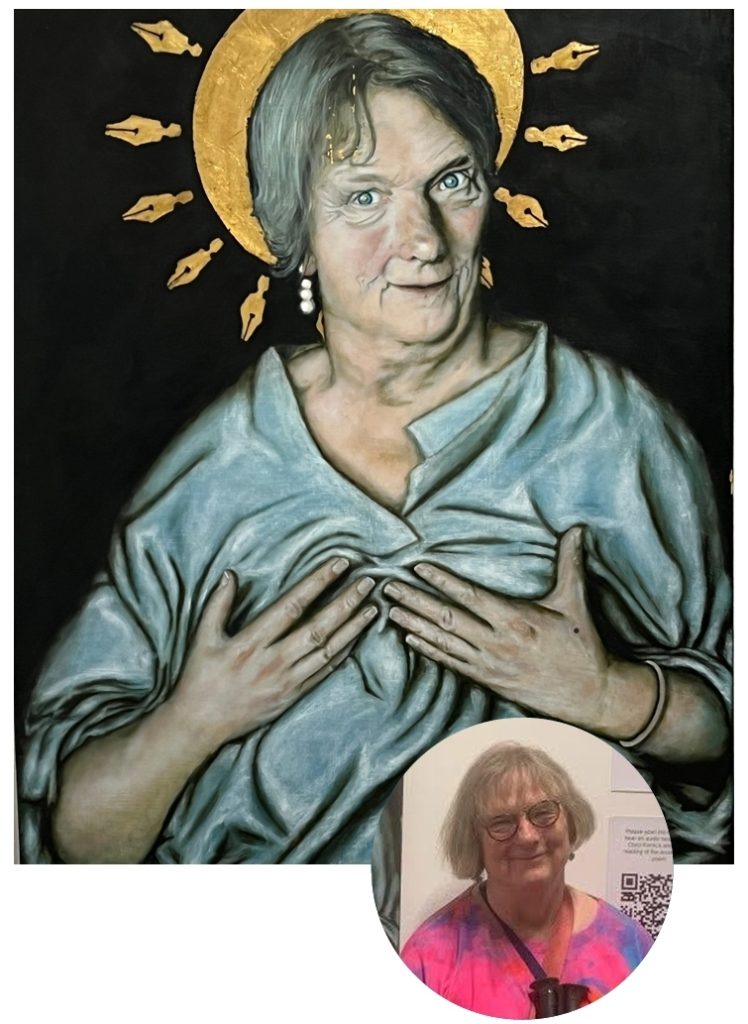
I wrote this poem to go with Chris Ferric’s portrait of me, for it to be exhibited in the No Vacancy gallery in Melbourne, Australia (no-vacancy.com.au).

This is my face

An old face

In a world that fears death

& tries to ignore it

& so fears old age

& tries toignore it too

But it won’t go away

Just as I won’t go away

This is my face

A trans face

In a world that wants men to be men & women to be women

& tries to suppress

Those of us who cross the line

Those of us who defy the frontiers

& wants us to disappear

But I won’t disappear

I love my femaleness

& I love my maleness too

Because I am old enough

To have known much hatred

& old enough to have overcome it.

So I love my aging

& death is my sister

& life my lover & friend


Chris Ferric wrote:

“Title/year of artwork: Saint Jo, Scribe of Our Souls / 2023-2024.

Medium: Oil and brass leaf on wood.

This painting is for Jo, my friends, my communities.

Jo is disabled, sexy, trans, old, and worthy of the care and attention required to paint an oil portrait made up of many caresses of her face and body.

Jo was ordained by The Order of Perpetual Indulgence. She is surrounded by a halo of golden nibs gifted by Brother Bimbo. This portrait bears scars from mishandling by a major state gallery. They aren’t hidden, they are part of her story, in gold.

Jo is manifest fully: father and grandmother; Elder; playwright; performer; Queen Jesus; St Jo, Scribe of Our Souls.”


I love them for saying that. I love the picture.

Seeing it in the gallery recently was the first time I had actually seen it as a real artwork. It sent shivers up and down my spine. There is something utterly miraculous in the energy of this picture and the life that shines out of it.

Chris has taken the most traditional art form imaginable and, with astonishing skill, subverted it on so many levels.

The portrait has just won a major art award. And I’m happy to see that Chris’s wonderful artistry is beginning to get the respect and appreciation it so deserves.

And as for the painting itself: It is so queer and so glorious it takes my breath away.

Jo Clifford was ordained an Elder of AUC on 23 March.

Open to the new – remembering Ian Rathjen

By Mandy Rathjen (From SeedApril – May 2025)

Dear Augustine friends,

I wanted to say a heartfelt thankyou for all the love, understanding and good company over all the years since Mum and Dad (Ian and Elizbeth Rathjen) first joined the Augustine community.

Augustine was central to their social and spiritual lives in Edinburgh and has been a constant through all the years when Dad was a carer for Mum and managing his own various health conditions with characteristic positive pragmatism.

We were held as a family in the weeks and months before Dad died and in the Thanksgiving Service, with all the usual Augustine behind-the-scenes thoughtfulness and action.

I first came to Augustine to help Mum and Dad on coffee duty about eight years ago, and with nice circularity I was ‘retrained’ this month to come back onto the coffee rota. I may now be almost trusted to operate the dish washer and the coffee machines, which were Dad’s domain, but his legacy on the finance committee, new membership groups, Bible readings, and enthusiastically taking part in all the quizzes, concerts and tea parties is his alone.

Love and peace, Mandy

Mandy adds that Ian had been editor of his school magazine and was happy writing the occasional article for Seeds. So, it’s fitting that we include here some of the memories of Ian gathered by his family for the Service of Thanksgiving, held at AUC on 7 January this year.

——————————–

If starting not at Dad’s birth but at his 90th birthday celebration in April of 2024 seems all a bit back to front, that may be true.

But that event was Dad in his element: smartly dressed, hosting a gathering, and addressing an audience with a well-prepared speech; that, and there being a big cake. There was, throughout his life, time for cake… biscuits… but, most importantly, pudding, without which no meal was truly complete and for which, to the consternation of the medical profession, he claimed to have an extra tummy. He was lucky in marrying Elizabeth, who didn’t have a sweet tooth but diligently cooked a multitude of sweet treats for nearly 60 years.

Dad was born in 1934 and grew up in Tolworth at the south-west edge of London, the first baby to be baptised at Tolworth Congregational [later, URC] Church. His parents had been very much involved in getting it built.

This is where he met Elizabeth, and they got engaged on a church holiday to Norway. His notable performance of ‘King Rat’ in the church pantomime (pictured right) had the dubious success of reducing the front row of small children to terrified tears, to the acute embarrassment of his teenage children. He had to ‘tone it down’ for the next performance.

“Dad sailed across the Channel, which showed the adventurous spirit of the times”

Dad was not infrequently in trouble as a boy, a symptom of an active and enterprising mind. He bought doughnuts on the way to school and sold them at a premium at the school gate. Sadly, this entrepreneurial initiative was frowned upon by the headmaster. He set up a fully timetabled model railway in the attic and would often annoy his Mum, saying he couldn’t come for tea until the 6.20pm had left the station.

London was a significant part of Dad’s life, from childhood shopping trips to working in Whitehall, and then for so many years visits to the opera at the London Coliseum that he and mum enjoyed.

Rivers were also important to him. As a teenager he built a canoe and a punt in his garden. He and friends travelled up and down the Thames on many weekends, with Elizabeth cycling along the tow path with a bag of sandwiches. In his 20s, Dad sailed across the Channel with his brotherin-law Roger, which showed the adventurous spirit of the times.

He and Elizabeth began married life living in an old mill above the river Waveney, a basic home but a happy time. Having excelled at the London School of Economics, he was working as an accountant in rural Norfolk – a job he enjoyed, visiting many local businesses, exposing accountancy irregularities, saving up, and looking ahead to being able to buy a house and start a family. Accountancy was to take him into the Civil Service and, from there, to become General Secretary of the Civil Service Benevolent fund, a post he enjoyed until retirement.

Service was important to Dad in his working life but also running the youth fellowship at church, and acting as a magistrate in Kingston upon Thames for about 20 years, ultimately chairing the bench, and the Probation service committee. He was very committed to developing probation services and worked almost fulltime hours in this voluntary capacity for many years. This was really Dad’s education and insight into the lives of many people less privileged that he had been. His attitudes and view of the world evolved, and this openness to new ideas and willingness to rethink remained a positive quality throughout his life.

He was a natural teacher, and latterly this was exemplified in the new membership classes at Augustine, which he helped to lead with Fiona for over ten years. Even in his last year, he attended the carbon literacy course at AUC and thought carefully about the need to change habits.

But if service was important, the family was more so, and while Mum very much ran the house, Dad was a keen reader of bedtime stories, the homework champion, a keen player of French cricket in the garden, and never too easy to beat at card or board games.

He had a keen mind and memory, which he liked to keep busy and agile. He sent off The Telegraph newspaper’s prize crossword every Saturday, even into his 90th year.

Dad was proud that his great, great, great grandfather, a young disinherited German farmer’s son, arrived in Leith and ended up married to the Customs officer’s daughter, living in the grand Customs House still standing near Leith harbour. This German/Scottish family ended up in Liverpool and then Dad’s parents moved to London. Dad returned to Edinburgh and enjoyed the last 18 years living in the same city his ancestor knew two centuries before.

Dad was a devoted husband and ultimately carer for Mum in her ten years of living with dementia. He came out of his comfort zone and began to take on much of the cooking and support for her. In his very last days, he continued to enjoy seeing family and friends, but when he lost the love of food, even pudding, it’s how we knew his time was at an end.