Everyday Normal – Sarah Jones tour

By Carol Joyner (From Seeds February – March 2026)

Towards the end of last year, Sarah Jones’s Everyday Normal tour came to Edinburgh, hosted in the sanctuary of St Columba’s by the Castle Episcopal Church.

The Revd Canon Sarah Jones, the first post-gender-change person to be ordained in the Church of England, is priest-in-charge of St John the Baptist Church in Cardiff. She is also a gifted public speaker and folk musician.

Having already received positive reports of Sarah’s entertainment value, the evening exceeded all my expectations, and some more.

The first half was dedicated to her outing as a transgender priest by the Daily Mail back in 2004, and the furore that followed, despite the support of her diocesan bishop in Hereford, Anthony Priddis. The second half, following a cake-enriched interval courtesy of St Columba’s Revd Juliet Stephenson and co, focused on Sarah’s current role at St John’s in Cardiff, and the public response to trans issues. Sarah then took questions from the audience.

Unsurprisingly, Sarah spoke to last year’s Supreme Court decision to define a woman as biologically female at birth, articulating several key arguments against the move, with a series of erudite and humorous takes on the topic.

I particularly enjoyed her well-made point around dangers and threats to women, which do not come from the tiny pocket of vulnerable trans women in society, but from cisgendered men. This has historically always been the case. The presence of intersex bodies and, therefore, identities that challenge biological and gender binaries is a further reality ignored by the political and evangelical right. The problem, as Sarah explained, is that the liberal left has not mobilised itself as successfully as anti-trans campaigners, often lacking the political nous to respond effectively to the wilful ignorance and hatred directed toward trans women.

Sarah’s humour proved an effective vehicle for making her points around both the vitriol of the right-leaning press and its public, and the sometimes self-defeating response of trans campaigners and their supporters, who are often disorganised and, at times, woefully naïve in their counterattacks. A recent TERFS versus Trans demonstration in central Cardiff was discussed, in which the trans side did itself no favours by becoming embroiled in petty jibes, suggesting on one protest sign that TERFS should be drowned in the River Taff. When invited to speak at the event, Sarah found herself at the centre of an X troll-fest, in which she was variously described as a ‘Christian lunatic’ and a badly turned out Darth Vader lookalike!

While Sarah’s presentation of her X-feed gave rise to much mirth among us, it did highlight the polarised views of the public towards trans issues and, to a lesser extent, the lack of respect afforded the clergy in today’s secular society.

What I particularly enjoyed about Sarah’s performance was her warmth and humanity. My wife and I arrived early to the event and Sarah was quite happy to chat away to us while setting up, and indeed mixed with the audience during the interval. She also took the time to respond thoughtfully to questions from the audience.

There was a refreshing lack of ego on display and she was unapologetically herself – clever, witty, erudite but also very, very human. Very everyday normal, in fact.
Making our wishes clear

From Seeds February – March 2026

On Thursday 7 May, parliamentary elections will be held in Scotland.

The Revd Fiona Bennett writes, ‘Particularly given the increase in poverty and hatred across the world, and the rise of the Reform party in the UK, the Scottish election in May is going to be very significant and important to engage with as people of faith.’

Fiona suggests three things for us to consider:

  1. To vote and to encourage others to vote.
  2. To use this election as an opportunity to raise concerns and hopes with candidates with both passion and grace.
  3. To pray for those in government, and all people, to be and build a more just and humane society.

GETTING READY TO VOTE

You can get information about key dates at the Electoral Commission website: www.electoralcommission.org.uk.

Another useful website is www.mygov.scot (go to Voting in elections in Scotland/How to vote).

You will not need photo ID for Scottish Parliament elections or local council elections (see Scottish Assessors’ Association – www.saa.gov.uk)

  • Monday 20 April: Deadline to register to vote
  • Tuesday 21 April (5pm): Deadline to submit your application for a postal vote or a postal-proxy vote
  • Tuesday 28 April (5pm): Deadline to submit your application to vote by proxy
  • Tuesday 28 April (5pm): Deadline to apply for free voter ID

YOUR POLLING STATION

You will get a polling card in the post before the election. This will tell you where to vote. If you haven’t received your polling card, contact your local council.

Opening times for voting: Thursday 7 May 2026, 7am – 10pm.

THINKING AHEAD

The ecumenical Joint Public Issues Team (JPIT), which brings together expertise from the URC, Methodist and Baptist Churches, offers resources and information around elections and broader political questions:

‘One of JPIT’s six hopes is for “A politics characterised by listening, kindness and truthfulness”. We believe that Christianity has a lot to say about politics. We cannot ignore the challenges facing society today, and we need to engage fully with democratic processes and decision-making. By participating in elections and political life, Christians can make a positive impact on the political landscape.’

JPIT’s website (jpit.uk) and posts on social media are always worth exploring.

AMNESTY’S MANIFESTO

Amnesty has published a human rights manifesto, setting out ten calls on the next Scottish government. Their priorities include maximising rights safeguards for people seeking asylum, fully decriminalising abortion, and respecting and protecting the rights of LGBTI+ people by banning conversion practices.

We may not agree with every point – but they are worth checking out to help us clarify which issues we do want to press our politicians on. Maybe these; maybe others.

Amnesty writes: ‘We want political parties to prioritise laws that will help create a fairer, more equal Scotland. These include a Human Rights Bill that will empower people to fight for a decent standard of living. We all deserve a warm home, proper healthcare and a financial safety net. None of those things are too much to ask for.’

Read the manifesto here: bit.ly/scotman26

Register for its launch on Monday 2 February from 6:30pm to 7:30pm GMT via Eventbrite: bit.ly/amnestyscot26.

When the world trembles

By Revd Charity Tozivepi-Nzegwu (From Seeds February – March 2026)

I have learnt that there are moments when the world trembles, not because violence has already erupted, but because the conditions for it are being normalised. When power begins to speak as though borders are optional, consent is irrelevant, and the lives of ordinary people are collateral.

Scripture teaches us to pay attention to such moments.

Woe to those who devise wickedness and work evil on their beds. When the morning dawns, they perform it, because it is in their power.’ (Micah 2:1) This is not merely about politics. It is about moral imagination. About whether the strong believe they are accountable. About whether might is mistaken for right. About whether law exists to restrain power or to be bent by it.

The scriptural wisdom tradition is clear. When authority forgets its limits, chaos follows. When force replaces dialogue, when domination disguises itself as order, when resources are valued more than lives, the earth itself becomes unsafe.

The kings of the earth set themselves, and the rulers take counsel together, against the Lord … He who sits in the heavens laughs’ (Psalm 2:2–4) Not because suffering is amusing, but because no empire is eternal.

There is a dangerous logic at work in the world, one that suggests that if power can act without consequence, then others will follow. Scripture rejects this utterly. Violence begets violence. Injustice multiplies itself. What is permitted for one soon becomes permission for many.

The prophetic tradition does not call us to cheer, nor to inflame, nor to choose sides hastily. It calls us to discernment. To truth telling. To remembering that law, justice, and restraint are not weaknesses but gifts that protect the vulnerable.

God is never impressed by military strength. God listens for the cries of those who will pay the price long after speeches are finished, families who will grieve, children who will inherit rubble instead of hope.

…Seek justice, rescue the oppressed, defend the orphan, plead for the widow.’ (Isaiah 1:17)

This is a moment for vigilance, not vengeance.

For wisdom, not bravado.

For courage that refuses the seduction of domination.

And for prayer, not the kind that numbs conscience, but the kind that sharpens it.

May we remain awake.

May we refuse the lie that force is inevitable.

May we remember that peace is not passive, it is disciplined, costly, and holy.

The Revd Charity Tozivepi-Nzegwu is a Methodist minister serving in the Cambridge area. She is Chair of the Methodist Church’s Justice, Dignity and Solidarity Committee. This article is shared in edited form with Charity’s permission.

Perspectives on LGBTQ+ History

By Sam Stone (From Seeds February – March 2026)

LGBTQ+ History Month is celebrated during February. It is a time to remember the origins of the LGBTQ+ movement, to honour those who came before us, and to reflect on both the progress made and the work still to be done.

Late on the night of 27 June 1969, police raided the Stonewall Inn, a Mafia-owned gay bar in Greenwich Village, New York. Police raids on gay bars were common, but they usually took place on quieter weeknights. This raid, however, was deliberately planned for a busy Friday night, with the intention of arresting as many people as possible and shutting down a Mafia-owned establishment.

What the police did not anticipate was resistance. People fought back, joined by a growing crowd of onlookers. Objects were thrown, violence broke out, and the small group of officers sent to carry out the raid were eventually forced to barricade themselves inside the bar until they were rescued by the fire brigade and riot police. The unrest continued for six days and became a pivotal moment in LGBTQ+ history.

Although the related movement was originally referred to as ‘the Gay Rights Movement’, Stonewall was not the beginning of activism. Groups such as the Mattachine Society in the USA and the Homosexual Law Reform Society in the UK had already been campaigning since the 1950s. However, Stonewall was felt globally. Across the world, people who had long been oppressed began to stand up and demand change. One year after the Stonewall uprising, the first Pride march took place.

LGBTQ+ History Month celebrates not only how the movement began, but also the achievements, contributions, and ongoing work of countless individuals and groups who continue to challenge discrimination and work for equality.

So why is this important? It is important to recognise past struggles – discrimination, homophobia, and transphobia – while also acknowledging how far we have come. It is about raising awareness, challenging prejudice, and helping to create a safer, more inclusive society.

For me, it is also about recognising how far some churches have come. At the age of 16, in 1996, I was told by a priest that God would turn away from me and that I would go to hell if I did not renounce ‘these ways’. I was scared, confused, and ashamed – frightened because I liked other girls, and not boys as I was expected to. I heard what people said about homosexuals, and I felt alone and forsaken for something I could not change.

I was never encouraged to explore my faith at home, so my faith grew quietly – through school, Brownies, and slipping into church when it was open. But after that encounter, I never went back to church. If I was not accepted by God, what was the point? It would be another 20 years before I returned. I never told anyone until eight years later, when I met my now wife.

How many young people – and older people too – still feel alone and scared today?

So, what has the Church done in relation to the LGBTQ+ movement? Although the Church in fact played a role in decriminalising sex between two consenting men in 1967, the Church’s shifting stance on homosexuality has often been painfully slow.

A significant moment came in 1998 at the Lambeth Conference, where Anglican bishops debated sexuality and passed Resolution 1.10 (bit.ly/1998lambeth). This committed bishops to listening to gay Christians, affirmed that they are loved by God, and condemned irrational fear of homosexual people while also rejecting homosexual practice as incompatible with scripture. Shortly afterwards, 150 bishops – mainly from the USA, UK, Canada, and Australia – issued an open letter pledging to work towards full inclusion in the life of the Church.

Progress continued, though not without conflict. In 2002, the Diocese of New Westminster in Canada became the first Anglican body to offer same-sex unions. In the UK, civil partnerships became legal in 2005, though they could not take place in churches. Same-sex marriage was legalised in England and Scotland in 2014, and the first same-sex marriage in a church took place in 2017. More at bit.ly/CofEsex.

In July 2016, the United Reformed Church (URC) General Assembly voted to allow individual congregations to decide whether to register their buildings for same-sex marriage. This made the URC the largest Christian denomination in Britain at the time to give this freedom to local churches. The URC continues to show its support through opposition to conversion therapy, support for transgender and non-binary people, and partnerships such as the Open Table Network opentable.lgbt.

Why does this matter? Because it gives people like me – and thousands of others – peace. It tells us we are safe, accepted, and valued. It reminds us that people in the past and in the future have fought and still are fighting so that we do not have to live in fear of being who we are, and so that future generations might be spared the torment experienced by so many before them.

Homophobia still exists. Young people are still frightened to tell their parents who they are, fearing rejection. So, what can we do? We can be kind. We can be supportive. We can listen, stand alongside one another, and choose love over fear.

Because at the heart of our faith is Jesus – who welcomed the outcast, challenged exclusion, and loved without conditions. Jesus loves us all, exactly as we are. No exceptions. No requirements. Just love.

Sam Stone is a member of the Justice, Peace and Integrity of Creation Group in the United Reformed
Church’s East Midlands Synod. This edited version of Sam’s article is shared with her permission. To read the full version, go to bit.ly/LGBTQhist26.

Being One

By Revd Juilet Stephenson (From Seeds February – March 2026)

This issue’s guest reflection comes from the Revd Juliet Stephenson, Rector of our Episcopal partner congregation at St Columba’s by the Castle since last summer.

I came up from the south coast, where I was leading a church community through a transition phase. While there, I introduced membership of Inclusive Church and introduced a church community network called ‘Open Table’.

To be welcomed into a covenant with ecumenical partners who all share the same values, vision and commitment to collaborative working is totally refreshing.

As The Local Church (TLC), we celebrated together the Week of Prayer for Christian Unity at St Columba’s on 18 January. To seek our similarities, rather than highlighting difference, is what Christian unity IS at its heart. It’s no surprise that I found this service so wonderful, for you have enabled this sort of thing to come very easily by your commitment as TLC communities. So, thank you!

What makes this for me so much more poignant is that ecumenism, when it is done with true communion, is so easy to achieve. I’ve been ordained for almost 22 years and have had wonderful relationships in all my communities with other Christian denominations. But sadly, within my former denomination, the Church of England, clergy and congregations living side by side bore so much difference that an outsider looking in had difficulty seeing the mission of God as a coherent message. Important issues that impact the lives of good, faithful people (lay and ordained) are ignored, dismissed and devalued. Fewer and fewer folk can easily find a place at God’s table.

Hence my deep joy at being welcomed to join the Scottish Episcopal Church and as the Rector of a wonderful church, topped off with being one of the common ministers within TLC.

Thank you for your welcome, your support, your heart for the gospel message of inclusion and the willingness to do things as ‘one’.

It would be amazing to get to the place where we see the fluidity of church as being ‘just the place my bum hits the pew’ – which pew (or chair) doesn’t matter, as long as week by week, Sunday by Sunday, we move ourselves into a place where we feel welcome and comfortable, and know we will grow in faith and devotion to Christ.

So, with that in mind, and our bums ready to sit on one another’s pews and seats, beanbags and floors – here’s to 2026!

Whatever we can do as one!
However we can support one another’s causes!
Wherever we land to worship! Let’s make sure that we do it with a heart for love, a heart of Christ and a heart for our family of fellow Christians.

With so much love and friendship for you all,

Juliet

Painting creation

From Seeds December 2025 – January 2026

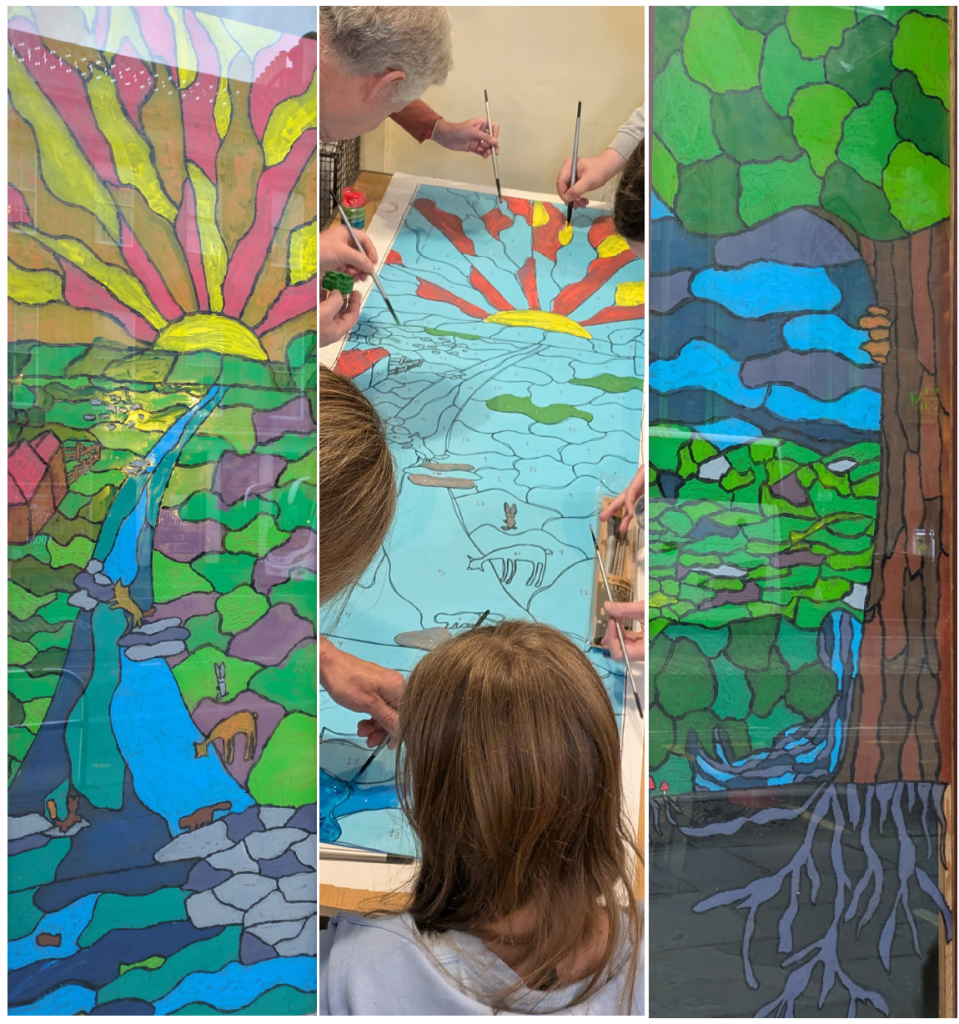
Anyone walking past Augustine at the moment will be struck by the ‘stained glass’ panels in our windows, each reflecting different aspects of creation.

During the Season of Creationtide (1 September to 4 October), members of AUC painted the designs. They were guided (‘painting by number’) by AUC member Aubrey Bader, who created the panels. The idea, said Fiona, was to help us ‘speak to the whole world about what we feel about creation as Christians’.

The panel themes illustrate different aspects of creation. One offers an overall creation scene; Aubrey called one ‘The Elder Tree’ – a large tree with a person resting in its shade – and one reflects the church’s dandelion logo – seeds dispersed and growing around Edinburgh’s Arthur’s Seat.

Aubrey, who is a landscape architect, said she wanted to look at creation from different scales – of Augustine itself, the wider community, and creation in general. She felt it was important to include detail and depth in each panel, for example a ladybird on a leaf, within ‘the big views’.

Our Evening with the Tik Tok Pastor

By Lewis Reay (From Seeds December 2025 – January 2026)

Queer and Christian is a powerful and affirming perspective for those at the intersection of queer identity and Christian faith’, said the Revd Fiona Bennett.

Fiona hosted AUC’s evening with Brandan Robertson to discuss his new book, Queer and Christian: reclaiming the Bible, our faith, and our place at the table.

In the book, Brandan tells his personal story of his faith and sexuality, including his experiences of conversion practices.

At this fundraiser evening organised by Our Tribe, Brandan talked eloquently about his early experiences in church, where he was welcomed until it became clear that he didn’t conform to expected narratives of sexuality and gender. While studying at Bible college he was told to undergo conversion therapy. This did not turn him straight! Instead, he found the queer community, progressive Christianity, and came out.

His insights into biblical passages that are gender non-conforming or expose sexuality between equal consenting adults showed us that there are queer narratives to be found and unpacked in scripture. He talked about Joseph and his coat of many colours. This was a female garment, and Joseph delighted in it. Joseph’s father Jacob recognised something in Joseph that was gender non-conforming, such that Joseph’s brothers repeatedly tried to kill him. This story is one of a marginalised person becoming the hero of their own life.

In the book, Brandan also tells stories about Jonathan and David, Ruth and Naomi, and the Ethiopian Eunuch – all characters whose stories reveal a queer narrative. Finding ourselves in the pages of scripture felt like a revelation for many in the audience.

During a Q&A session, Brandon also paid tribute to the Jewish teaching and texts that laid the foundations for Jesus’ life and ministry and the establishment of the early church. Asked about a bisexual reading of the story of David and Jonathan, he agreed that from a bisexual lens this would be interesting. Another person asked whether a queer identity was a ‘thorn in the flesh’ and Brandan told us that rather it is a gift – a blessing to be celebrated as we are made in the image of God. He also spoke of the impact of Metropolitan Community Churches upon the progress of affirming and inclusive churches throughout the world.

This event was supported by a partnership of city centre churches: St Columba’s by the Castle, Greyfriars Kirk, St Giles Catherdal, Edinburgh New Town Church, Metropolitan Community Church and Augustine United Church. With over 50 tickets sold, it was a busy and engaging evening. We raised £350 for the Equality Network and Scottish Trans.

In the next issue of Seeds, Carol Joyner reviews ‘Everyday Normal’ – the Sarah Jones tour

Wholeness and Holiness – working towards disability justice at AUC

By Siân Joyner (From Seeds December 2025 – January 2026)

At AUC’s October Church Meeting, Siȃn Joyner and Mike Holroyd spoke about disability in a faith context. They hope it will be the start of a journey towards disability justice at AUC. Here, Siȃn identifies some of the issues.

Would you like prayer for your leg?’ someone asks.

As I stand in a bus shelter, waiting for a friend for a coffee date, he wakes me from a daydream. I think about lecturing him and his two accomplices on the figurative nature of the healing stories; I think about telling them to ‘do one’. But I’m tired, and nodding seems like the path of least resistance. These three students are on a mission. They have no banner, no identity; they have randomly approached me on their way to church. They are young. They pray for healing. I thank them. They walk away. They saw the ankle-foot orthosis. And, having seen it, I guess they assumed my leg was broken, in need of healing.

Recent books, such as Amy Kenny’s My Body Is Not a Prayer Request: Disability Justice in the Church, assure me that I am not alone in this experience. Amy, a disabled academic herself, writes about ‘prayerful perpetrators’ who want to pray for bodily change in her, when in fact a cure is not wanted. She discusses the distinction between ‘cure’ and ‘healing’.

Such anecdotes speak volumes to deeply ingrained prejudices and attitudes toward disability. In sacred spaces, they point to an ableism that ‘others’ disabled people, and casts them as a metaphor for weakness, or even as a reflection of sinfulness.

So, how can we embrace a theology that celebrates disabled people as an equally valuable part of the diversity of God’s realm?

I didn’t always view disability as positive. As a small child, my father told me about how the ‘whole church’ prayed when I was born, and in hospital. My parents took me to spiritual healers to ‘maybe, make me better’. Where disabled people were to be found in the Bible stories that were read to me as I grew up, none of those people stayed disabled. They were cured, and I was not. That wasn’t fair. Throughout my childhood, the narrative that being disabled meant that there was something ‘wrong with me’ loomed loud from a pulpit that readily associated disability with sin and punishment. I was angry with a world made for two-handed, mobile people, and with a God who would render me disabled from before I was born.

But what if there was a different understanding of wholeness to be found?

It was my academic reading that first suggested that the wider Church’s teaching I had heard as a child, that disability and healing are about deficit in a person’s body or mind, was wrong – or, at least, ill-informed. The social model of disability tells us that disability isn’t about a person, so much as the place in which they find themselves. A woman may need to use a wheelchair to get around, because her legs are weaker in some way, but it is when the lift is broken, or the ramps absent, that she becomes disabled. A child may not be able to hear the spoken word. But it is when their signed language is not understood by those around them that their communication may be disabled.

Affirmative models of disability go further still, challenging the nondisabled person’s gaze on a disabled person as a lesser being, and holding out a positive collective identity for disabled people. In this frame, disabled people are to be celebrated. In this frame, disabled joy, refusing to be aligned with a narrative of pity or pain, is resistance.

With this in mind, upon returning to the Gospel stories, I sought out and heard more contemporary exegeses of the stories of disabled people in the Bible, as well as the ‘healing’ miracles. When we read the story of Zacchaeus, for example, who climbed a sycamore tree to see Jesus, we are told that because he was short in stature, he could not see through the crowd (the Gospel of Luke, 19:3). It is the crowd that disables him, not his height.

Elsewhere, at the pool at Bethesda (John’s Gospel, chapter 5), Jesus heals a disabled man, freeing him from the poverty that was associated with paralysis in biblical times. Such healings may be read as stories of social emancipation and condemnation of such roots of poverty.

What does that mean for a disability-affirming sacred space?

This theology offers me an actionable frame of reference today, to understand both my own relationship with God and with disability, and to think about ableism and disability justice more widely. From here, we can begin to think of ways of making our church community more welcoming and inclusive of disabled people. We can think about the language we sing in our spaces. What does it mean if we sing:

Gather us in, the lost and forsaken
Gather us in, the blind and the lame…

How can we challenge (and if you’re paying close attention, we have challenged, in our singing) disability as a metaphor for weakness? How do we make our spaces more accessible? Who are we remembering to include, and whose needs aren’t being met in the way that we worship and meet together at AUC?

When we, as Christians, seek to make our communities more accessible and inclusive, by changing the places, rather than the people with which we find ourselves, we begin to re-imagine the world as one where everyone is welcome, and where we undo years of systemic injustice.

Mike Holroyd and I began to unpack this at a church meeting in October. Watch this space for how you can become involved in our work towards greater disability equality at AUC.

Siân Joyner (née Jones) is a queer, neurodivergent and disabled Elder at Augustine United Church, Edinburgh.

Advent’s invitation

By Revd Fiona Bennet (From Seeds December 2025 – January 2026)

The people who walked in darkness have seen a great light.’ Isaiah 9:2.

The people who walked in darkness were people who had been driven from their homes and their country of Judah to live in the land of their oppressor, the superpower Babylon. From what we can tell, the captive people taken to a foreign land were not treated as slaves there but the status, quality and opportunities of many of their lives diminished.

Their homes lay open for others to take, and their homeland was a province of Babylon. They were forced to build new lives in an unfamiliar and unwelcome place. Where would they find the energy? How could they sing the Lord’s song in this strange and unwelcome land? (to quote the psalmist). The prophet Isaiah described the experience as ‘walking in darkness’.

But while in the darkness they found light; hope was born. Hope that, despite their circumstance and history, God had not abandoned them. Hope that their situation would not always be or feel so bleak. The future was still uncertain, like a newborn child full of potential, but that potential, held in God’s promise, gave people a reason to keep on living in faith.

Sadly, in our world today there are many people who know what it feels like to be driven from their homes, lives and land, and even among those who have not experienced this horror there are many other experiences in our world today of bleakness and the sense that we are walking in darkness.

Advent is the season which invites us, while in darkness, to see the light. Advent invites us to discover the Hope that God has not abandoned us and even now is working to create new life from the ashes of the old. Advent invites us to keep living in faith; trusting that the one who comes to us in Jesus is with us walking in the darkness, loves us infinitely; and, even when unseen, is always steering us towards the potential of goodness for all. Hope in the darkness.

Paracetamol with peace of mind

By Alex Pedan (From Seeds October – November 2025)

Worrying about plastic pollution and climate change can give you a headache, and find you reaching for some paracetamol. But did you know that paracetamol is actually a petroleum-based product, requiring oil for its manufacture? Sair heid?

Don’t worry though. Help is on the way from a local scientist, and the friends that live inside us all.

Professor Stephen Wallace’s lab at the University of Edinburgh has discovered that bacteria can be genetically re-jigged to make our favourite analgesic. Also, they can be made to clean up plastic waste at the same time.

The bacteria in question, E. coli, are the ones that are found everywhere, including inside our guts, helping us digest food and generally stay healthy. Over the last four billion years or so they’ve been happily doing their usual thing of growing – dividing – dying – repeat, using a grab bag of chemicals available to them in the natural environment.

However, if you take them into the lab and block some of their genes, they become unable to use their usual building blocks.

Unfazed by this insult, if you give them the breakdown products of waste plastic, they can use those instead.

This was the first breakthrough of Professor Wallace’s lab. Their second was to hunt for certain genes in soil bacteria and fungi. If they put these into their plastic-busting E. coli, they could get them to make paracetamol. So, they now have a micro machine to clear up our plastic mess and make something useful from it. Hurrah.

It’ll take quite a while for this to be scaled up to replace the traditional manufacturing process, but hopefully less than four billion years!

For more info…
‘Scientists use bacteria to turn plastic waste into paracetamol’